

Are you carrying any power banks in your checked baggage?
The question my colleagues and I ask every day is: “Are you carrying any power banks in your checked baggage?” Suddenly, you start wondering: Wait, am I even allowed to bring this on board?
You’re not the only passenger who has this question. As an airline handling agent, I see this situation every day at check-in counters. Power banks are one of the most common items passengers ask about, if they can take power banks on board their flights, and with battery regulations updated and reviewed regularly, even experienced travellers often want to confirm the latest rules before flying.
Here’s the simple answer: yes, you can bring a power bank on your flight — but it must be packed in your hand luggage, never in your checked baggage. If you’re travelling with a higher-capacity power bank, there may be additional requirements you need to check before departure.
Let me guide you through the rules step by step, the same way I would explain them to a passenger at the airport — clearly, practically, and without unnecessary technical language.
Quick Answer: Power Bank Rules at a Glance
Short on time? Here’s the cheat sheet:
| Situation | Allowed? |
|---|---|
| Power bank in hand luggage | ✅ Yes |
| Power bank in checked baggage | ❌ Hard no |
| Under 100 Wh | ✅ No approval needed |
| 101–160 Wh | ⚠️ Only with airline approval |
| Over 160 Wh | ❌ Not allowed at all |
| Max power banks per person | 2 (global rule since March 2026) |
| Charging your phone mid-flight on Lufthansa/Eurowings/British Airways/Iberia/Vueling/Aer Lingus/Air France-KLM/Turkish Airlines/EasyJet | ❌ Not allowed at all |
| Charging your phone mid-flight on Ryanair | ✅ Generally fine, except during taxi, take-off, and landing, or when instructed otherwise by the crew. |
Why Do Airlines Even Restrict Power Banks on Board Their Flights?
You might be thinking — it’s just a charger, what’s the big deal? Here’s what’s actually going on.
It’s All About the Battery Inside
Power banks run on lithium-ion batteries — the same technology that powers your phone, your laptop, and basically every gadget you own. The European Union Aviation Safety Agency (EASA) actually classifies power banks not as regular electronics, but as spare batteries. That might sound like a boring technical detail, but it’s the reason they’re treated differently at airports.
They Can Catch Fire — And It’s Serious
Here’s the thing about lithium-ion batteries: when something goes wrong — a crack, a manufacturing fault, overcharging, getting crushed — they can overheat through a process called thermal runaway. Sounds dramatic because it kind of is. One cell overheats, spreads to the next, and before you know it, you’ve got a fire on your hands.
This isn’t just a theoretical risk either. In January 2025, a power bank in an overhead locker on a flight caught fire so badly that the aircraft had to be written off entirely. Everyone got out safely, thankfully — but it shook the whole aviation industry and kickstarted a wave of new rules worldwide.
Why the Cabin and Not the Hold?
Here’s the logic that makes total sense once you hear it: if a power bank starts smoking in the cabin, a flight attendant can see it, grab it, and deal with it. If it’s buried in the cargo hold? Nobody knows until it’s a much bigger problem. That’s exactly why every major aviation organisation — EASA, IATA, ICAO, and the FAA — insists your power bank stays with you in the cabin.
Can You Take Power Banks on Board in Hand Luggage?

Yes! This is exactly where it belongs.
Most passengers bring their power banks through security every single day without any drama at all. As long as it’s within the size limits and the right quantities (more on that below), you’re good to go.
A couple of small things that make the whole process smoother:
- Keep your power bank protected — in its original box, a little pouch, or even just wrapped in a plastic bag. This stops any accidental short circuits.
- During the flight, keep it under the seat in front of you or in the seat pocket in front of you — not in the overhead bin. This applies to almost every European airline now.
- If your cabin bag gets taken away at the gate to go in the hold (it happens, especially on full flights), grab your power bank out first and keep it with you. This is really important.
Can You Put a Power Bank in Checked Baggage?
No way. Not even a little bit. This is a firm no.
We know it can be tempting when your carry-on is stuffed, and you’re trying to squeeze one more thing into your suitcase — but please, don’t do it with your power bank. This is strictly for your own, your companions’, other passengers’, and flight crew members’ safety.
EASA, the FAA, IATA, and ICAO all say the same thing: spare batteries and power banks must never go in checked baggage. Full stop.
And it’s not just a rule on paper. An EasyJet flight from Egypt to London was diverted all the way to Rome because a passenger had a power bank in their checked bag in the hold. The whole plane had to land unexpectedly — imagine how that went down with 180 other passengers!
If security finds a power bank in your checked bag, it will be removed. You might even get pulled out of the boarding queue while they dig it out. Save everyone, including yourself, the stress and keep it in your hand luggage.
Power Bank Capacity Limits — What Do the Numbers Mean?
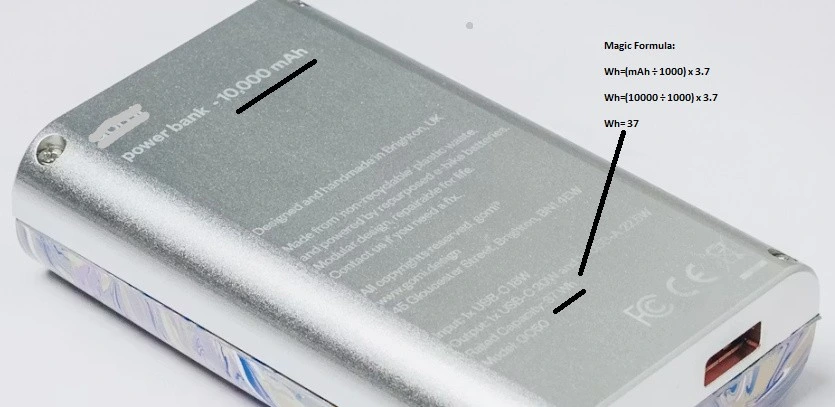
Okay, this is where passengers get a bit confused — but I’ll make it easy.
Airlines don’t measure battery size in mAh (the number printed on most power banks). They use watt-hours (Wh). Here’s a super simple formula to figure out your power bank’s Wh:
Wh = (mAh ÷ 1000) × 3.7
So a 20,000 mAh power bank? That’s (20,000 ÷ 1000) × 3.7 = 74 Wh. Totally fine!
Now here’s how the three tiers work:
Under 100 Wh — You’re absolutely fine to go.
This covers the vast majority of power banks people actually travel with. Anything up to about 27,000 mAh falls under 100 Wh, and you can bring it in your carry-on without asking anyone’s permission. No forms, no calls to the airline — just pack it and go.
As of March 27, 2026, ICAO introduced a global rule: a maximum of two power banks on board per passenger. So you can bring your main one and a backup, but not a whole collection.
101–160 Wh — Check With Your Airline First
Got a big power bank for a long trip or professional gear? You’ll need to contact your airline before you fly. These larger banks can be allowed — up to two per person — but the airline has to give you the green light in advance. Don’t assume it’s fine; actually get confirmation.
Over 160 Wh — Leave It at Home
Anything above 160 Wh simply isn’t permitted on passenger flights. No exceptions, no workarounds. If your power bank falls in this category, it’s staying on the ground.
Power Banks on Board Rules on European Airlines — Who Says What?
Different airlines have slightly different rules, so here’s a quick rundown of the big ones you’re likely flying with.
Lufthansa & Eurowings & major European Airlines
Strict new policy:
- Max two power banks per person
- Each one must be 100 Wh or under (up to 160 Wh only with advance airline approval)
- You cannot use your power bank to charge anything during the flight — that’s a complete ban on in-flight use
- The only exception is if you need it to power a medical device
- Must be stored under the seat or in the seat pocket, not in the overhead locker
So if you’re carrying a power bank, it is basically a passenger that isn’t allowed to do anything. It just has to sit there quietly.
EasyJet
EasyJet follows a similar approach. Power banks are banned from checked bags entirely. Under 100 Wh? Welcome aboard, no questions asked. Between 100 Wh and 160 Wh? You’ll need to get airline approval first. And if your power bank has ever been subject to a safety recall, it’s not allowed on the flight at all.
Ryanair
The key rules: carry-on only, keep it under the seat or on your person, and don’t use it during taxi, take-off, or landing. Anything over 100 Wh isn’t allowed at all — not in the cabin, not in the hold.
What Actually Happens at Airport Security?
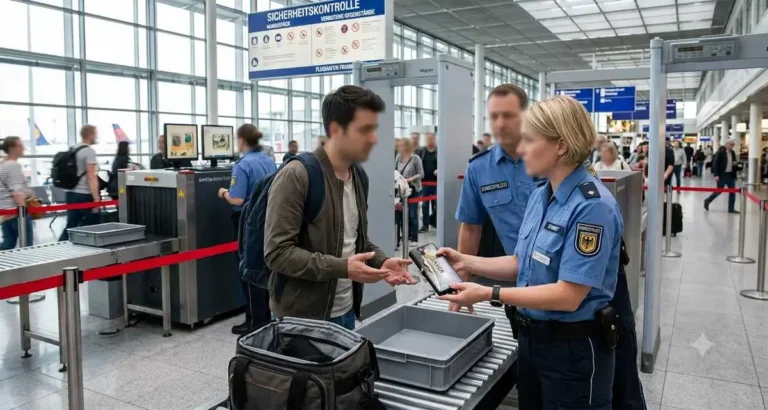
Wondering what to expect when you’re carrying your power bank through security? Here’s the honest picture:
Your bag might get pulled aside. Power banks can look a bit bulky and unfamiliar on X-ray screens, so security staff sometimes ask to check them separately — just like laptops. It’s totally routine, nothing to stress about. It is advised to take it out of your handbag so that it can be seen before the tray goes for the X-ray screen.
Make sure the capacity label is visible. If security can’t see the Wh rating on your power bank, they may not be able to confirm it’s within the rules. No label = potential problem. Check yours before you leave home. If it only shows mAh, you can write the Wh on a sticky note and tape it to the bank — or just know your calculation in advance. But there is no guarantee of that, it is better not to risk having a power bank with no specifications label while you are travelling by air.
Damaged batteries won’t make it through. A swollen, cracked, or suspiciously warm power bank will be flagged. The FAA is clear that damaged batteries shouldn’t be carried at all. If your power bank looks a bit rough, better to leave it behind.
Stay calm and helpful. If security wants a closer look, just cooperate, point to the label, and explain what it is. It rarely takes more than a minute.
Common Mistakes Travellers Make (Don’t Be That Person!)
Look, we’ve all made travel mistakes. Here are the power bank ones worth avoiding:
Throwing it in the checked bag. The most common mistake by far — IATA found that around 45% of passengers think this is fine. It’s not, and it can get your bag pulled from the flight. When the check-in agents ask you if you are carrying a power Bank or other dangerous goods in your checked luggage, just be honest and inform them if you have. Remember your safety.
Travelling with a damaged power bank. That slightly puffy, warm, or cracked charger sitting in your drawer? Leave it at home. It shouldn’t be on a plane, and security may not let it through anyway.
Packing a power bank with high capacity. That high-capacity bank you use for camping trips might be over 160 Wh. Check the label before you assume it’s okay to fly with.
Not knowing your Wh rating. If you get asked at security and you have no idea what your battery capacity is, things can get awkward fast. A quick check before you leave the house saves everyone time.
Frequently Asked Questions
Can I take more than one power bank?
Yes — up to two per person, following ICAO’s global rule that came into effect on March 27, 2026. Both need to be within the permitted capacity limits. So you can bring a backup, just not a whole suitcase full of them.
Can I charge my phone mid-flight using my power bank?
Depends who you’re flying with! On Ryanair, you can generally use your power bank during the flight, just not during taxi, take-off, or landing or when the crew ask you not to use it.
What if my power bank doesn’t have a capacity label?
This is genuinely a problem. Security staff need to verify that your bank is within the allowed limit, and if there’s no Wh label, they can’t do that. Check the manufacturer’s website, dig out the original box, or calculate it using the mAh number and the formula above. If you truly can’t figure it out — leave it at home for this trip. If I were you, I would not carry a power bank with no manufacturer specifications label on it.
Are power banks allowed on flights within Europe?
Absolutely yes. All European airlines operating under EASA rules follow the same framework. Whether you’re flying from Berlin to Barcelona or from Munich to Madrid, the same rules apply.
Final Thoughts
Here’s the honest summary from someone who has been working in the aviation industry for over 40 years, and still every day I see people in the airport with doubts about their power banks — travelling with a power bank in 2026 really isn’t complicated, as long as you know three things:
- Hand luggage only. Always, no exceptions. Keep it with you in the cabin, tucked under your seat.
- Check your capacity. Under 100 Wh and you’re completely worry-free. Between 100–160 Wh, call your airline first. Over 160 Wh, it stays at home.
- Know your airline. Your power bank comes along for the ride but can’t do anything during the flight. Ryanair? You can plug your phone in and top it up mid-flight, no problem. Except during taxi, take-off, and landing, or when instructed otherwise by the crew.
Pack smart, check the label, and you’ll breeze through security like a pro. Trust me. Safe travels!